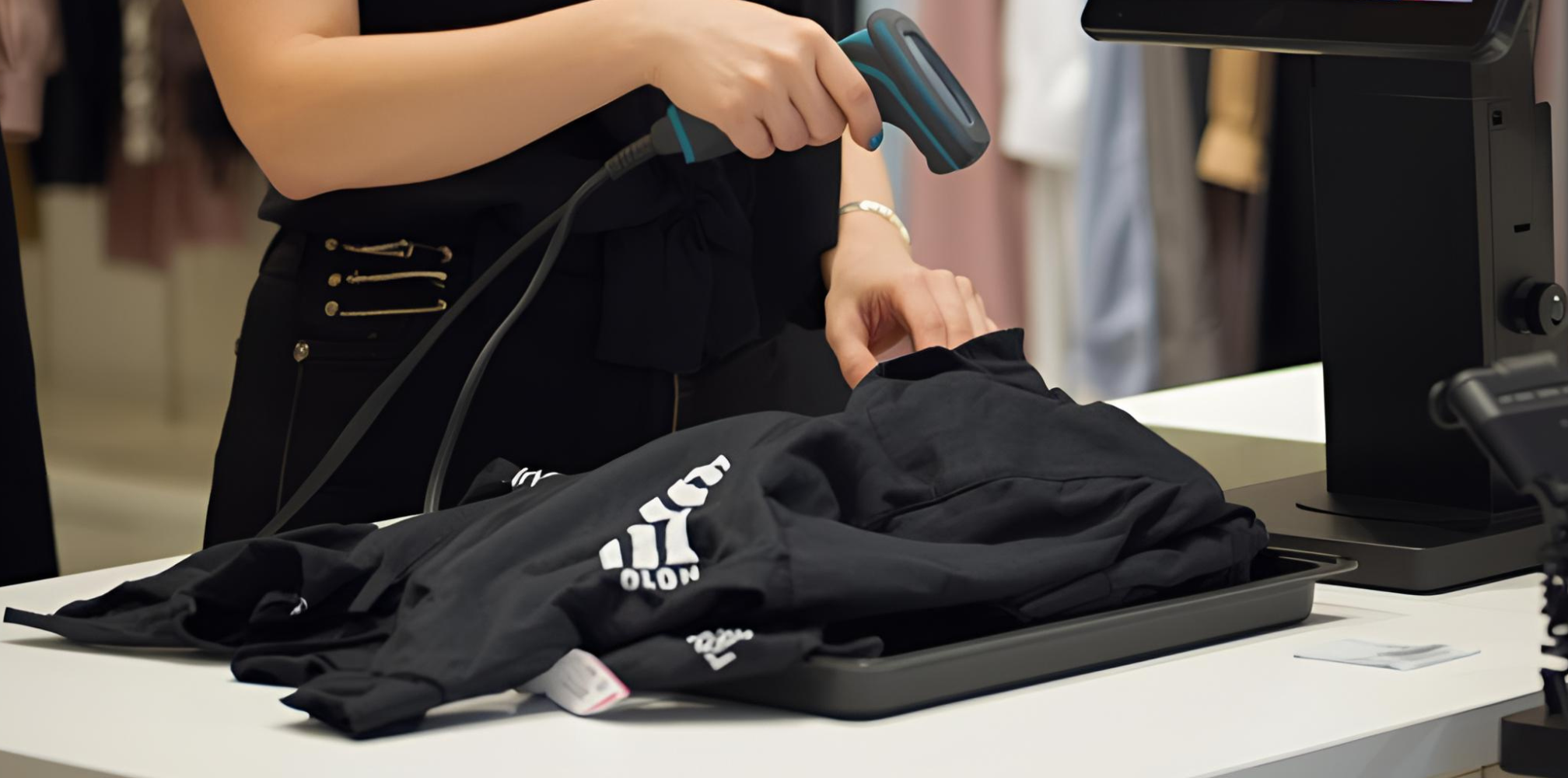
From fashion data to POS integration: how to make product data workable for retail.
In fashion, the problem often appears technical. The POS system feels limited. The webshop lacks information. The order flow falters. But those who look a little deeper usually see something else. The primary bottleneck is not the software, but the data that arrives too late, is incomplete, or in the wrong structure. That is precisely where time is lost. For brands that continue to send separate files. For retailers who still have to enter and/or correct data. And for POS suppliers who do have a good system, but are still too often dependent on manual data entry at their customers' sites. That is why fashion data, a smart POS integration, and good product data for retail are not separate topics, but one operational story.
Why article data in fashion still gets stuck too often.
Fashion is not a standard retail category. You work with sizes, colors, variations, seasons, images, and price updates that all need to be available at the right moment. As soon as there is noise in this process, the work shifts to the shop floor. Descriptions are then adjusted, photos are searched for, and barcodes are re-checked. That is precisely why Latest Collection positions itself as a neutral data layer: brands supply their data once, the platform checks, structures, and enriches that data, and connected software partners with an integration make it available in existing systems. Not by replacing systems, but by making them work together better. Anyone who wants to see how this chain is technically put together can already find the basic structure of that flow on page hoe het platform werkt , which describes how the platform works.
Why EDI fashion is important, but not always enough.
EDI is essential in fashion. It is the standard for order, delivery, and invoice flows, and systems like FashionUnited eBusiness demonstrate just how powerful this message exchange can be. It ensures speed, structure, and reliability throughout the supply chain. However, in practice, not every data stream starts as EDI.
Many brands still work with Excel files, CSVs, or separate exports. This is not a problem in itself, but it does mean that this data is not immediately usable within EDI environments. And that is precisely where the gaps arise. The order might be processed via EDI, but the product data required for the checkout, webshop, or marketplace lags behind or still needs to be manually supplemented.
That is where Latest Collection’s role lies. Brands can easily supply their data, for example via Excel. This data is then checked, structured, and converted into a format that *does* work within connected systems, integrations, and EDI environments. All without brands having to completely adapt their working methods.
The power therefore lies not in EDI or product data, but in connecting both. EDI handles the message exchange. The data layer ensures that the content is correct. Only when these two come together does a chain emerge in which systems not only communicate but are also directly usable on the shop floor.
What a smart POS integration changes.
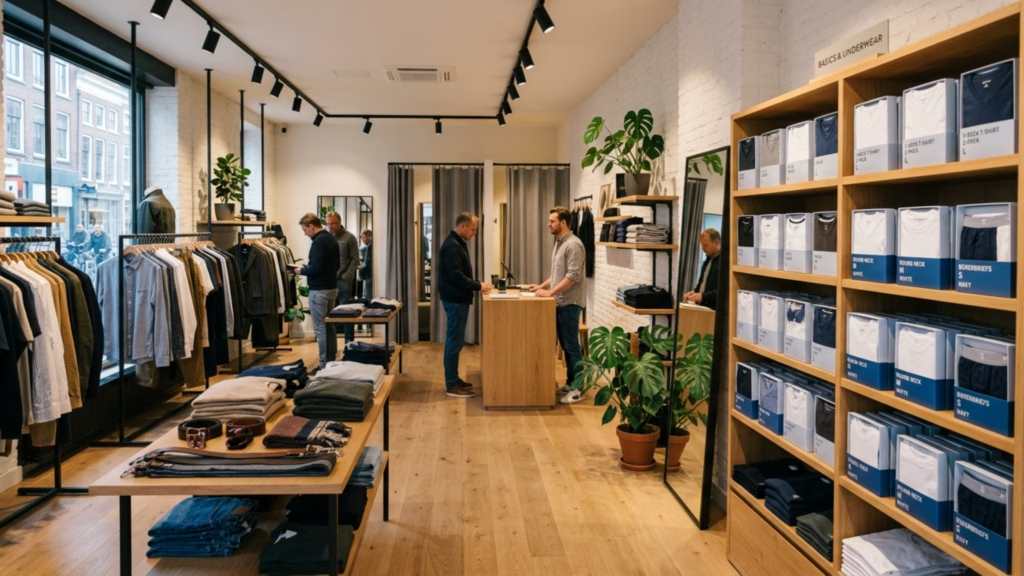
A smart POS integration changes more than is often thought. For brands, it means peace of mind and scalability, because they no longer have to adapt their data per retailer, but have one central delivery that becomes usable everywhere. For retailers, it means less typing, a lower risk of errors, and above all, speed. The collection is no longer stuck in the process but can go on sale almost immediately. For POS suppliers and resellers, it means a stronger proposition. You are not selling a system that still needs to be populated, but an environment that is usable from day one. You feel that difference immediately in sales conversations, implementations, and ultimately in customer satisfaction.
How partners make that difference visible in practice.
You see that difference reflected with partners who already have an integration in how quickly a collection is actually ready for sale.
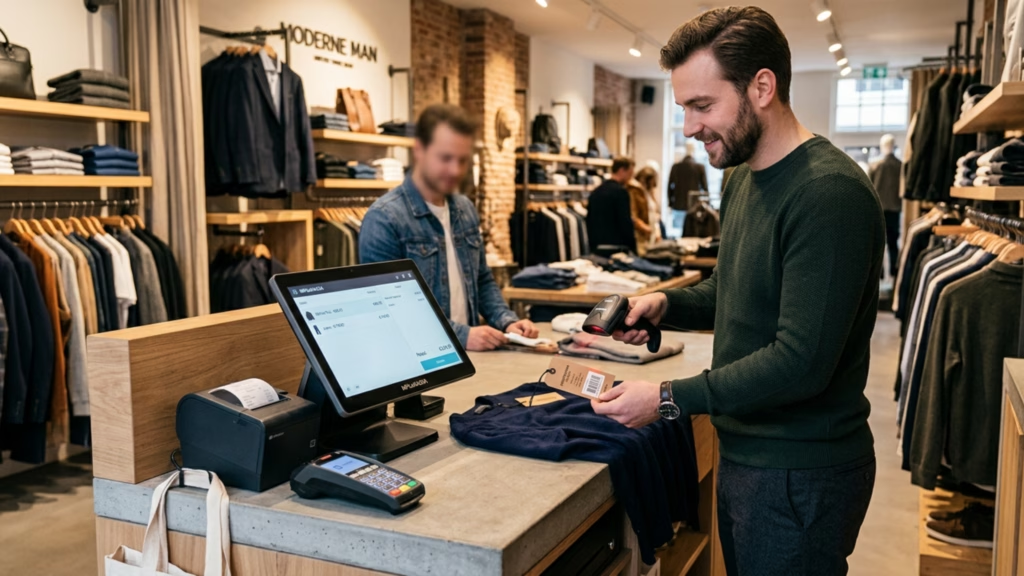
With MplusKASSA, you can see how a collection arrives and is ready for sale almost immediately in both the POS system and the webshop. MplusKASSA utilizes EDI capabilities, but the real gain lies in what happens alongside it. Product data, barcodes, and images are already available the moment the goods arrive. As a result, the work shifts from data entry to verification, allowing a retailer to start selling much faster.
The situation is similar for EasyPOS software, but without reliance on EDI. Here, it revolves entirely around the availability and quality of product data. As soon as this arrives consistently, correction rounds and manual work disappear. The difference lies not in technology, but in speed and ease of use for the retailer.
With FashionUnited eBusiness, you can see how EDI and complementary data streams reinforce each other. Their platform is strong in messaging, but not all brands deliver via EDI. Latest Collection complements this. Brands that supply data via Excel, for example, are still converted into usable product data so that it becomes available within their environment. This significantly expands the reach of available data.
For Retail2Market, the profit lies primarily at the front end of online sales. As soon as missing images are automatically added, a product feed changes from incomplete to immediately ready for sale. This not only accelerates activation but also increases the quality of what is visible online.
Within LEZA and ACA, you see the same pattern as with EasyPOS. The power lies in simplicity. Scan, download, and sell. No detours, no extra steps. Data is ready the moment the retailer needs it.
Across all these partners, you see a common thread. It is not a new feature that makes the difference, but the timing of data availability. As soon as that step is right, the rest of the process automatically becomes faster, simpler, and more workable.
Which brands are already ready in your system.
The story remains abstract as long as you don't see what is already available. That is why the brand pages are one of the most important parts of Latest Collection. They show immediately which brands are already supplying data and which product data and images are available the moment you need them. With more than 1,000 fashion brands and millions of barcodes, chances are that a large part of your assortment is already included. Check it out for yourself via the brand overview on this page.
For retailers and resellers, that is often the first real eye-opener. Not the question of what the platform does, but the question: are my brands already in it? And in many cases, the answer is yes. This means that a large part of your collection no longer needs to be built up manually. You scan, check, and can proceed immediately. The moment of arrival thus changes from data entry to preparing items for sale.
For brands, it works exactly the other way around. The brand pages show whether you are already visible and where you are still missing opportunities. Submitting correctly just once means you immediately connect to a growing network of retailers and systems where your collection is already expected.
This shifts the role of brand pages from something informative to something practical. It is not just about looking at what exists, but immediately recognizing what it means for you and where you can accelerate today.
What this specifically means for your situation.
Ultimately, it is not about the system, but about what happens the moment a collection arrives. If the data is accurate and available, the start of the sales process changes completely. For retailers, this means they can switch gears faster and are less dependent on manual work. For POS suppliers and resellers, it means implementations run more smoothly and the value of their system becomes immediately visible. For brands, it means their collection is presented consistently and completely, without having to adjust anything for each customer.
The question, therefore, is not whether this is relevant, but where you stand now. Are you still working with separate files and manual steps, or are you joining a structure where data is already ready the moment you need it?
Built for Fashion. Designed for You.